


Your Complete Guide to Tax Returns for Police Officers and Nurses
If you work in policing or nursing, your tax return deserves more than a rushed 20-minute effort after a night shift. This guide walks you through the work related expenses you can claim, the records you need, and the planning strategies that can make a real difference to your tax refund each year.
The typical lodgement window runs from 1 July to 31 October for self-lodgers. Using registered tax agents like Elite Tax and Wealth Advisory can extend this deadline if you are on their lodgement program by 31 October. Whether you are a police officer or a registered nurse, many of the principles overlap, though the details around uniforms, equipment, car expenses and self education expenses differ. This guide covers what you can claim, what you cannot, how to prepare, and when professional advice helps most.
Who This Guide Is For: Police Officers, Nurses and Midwives
This section helps you see where you fit and confirms the guide applies to your situation.
Police: Sworn officers in the WA Police Force, AFP and other state forces, including general duties, detectives, highway patrol, specialist units and recruits.
Nurses: Enrolled nurses, registered nurse professionals, midwives and direct carers across public hospitals, private hospitals, aged care and community settings in Perth and WA.
Many examples also apply to paramedics, correctional officers and other first responders, but the main focus is police and nurses.
This article assumes ATO guidance current for the 2025–26 income year. Check for rule changes each July.
When to Start: Tax Time Timeline for Police & Nurses
Getting your timing right at tax time reduces stress and avoids missed deductions.
Late June: Collect rosters, logbooks, training records and receipts before the financial year closes.
Mid-July to August: Employers like WA Police, WA Health and private hospitals finalise STP income statements. Your myGov prefill is usually ready by mid-July.
Late July to early September: The ideal window for shift workers to lodge, once prefill data is complete but before the October rush.
31 October: ATO deadline for individuals lodging themselves. Tax agents can often provide extended dates.
New graduates and recruits: If you changed employers during the year, watch for multiple income statements. All salaries, wages, and allowances must be reported to the ATO.
What Police and Nurses Can Generally Claim as Tax Deductions
Police personnel can claim work-related tax deductions for expenses incurred while earning income. The same applies to nurses. Before diving into specifics, understand the ATO’s three golden rules:
The expense relates directly to earning employment income
You spent the money yourself and were not reimbursed
You have records to prove it
Common deduction categories for both roles include:
Car expenses for work trips and travel between workplaces
Compulsory uniforms and protective gear
Professional associations and union fees
Work related self education expenses
Phone, internet and home office costs
Tools and equipment
Overtime meal expenses where an allowance is received
Tax offsets rather than occupation-specific tax credits are primarily provided in Australia, so maximising legitimate deductions is the main way to improve your tax refund. Overclaiming, however, can trigger ATO review or penalties.
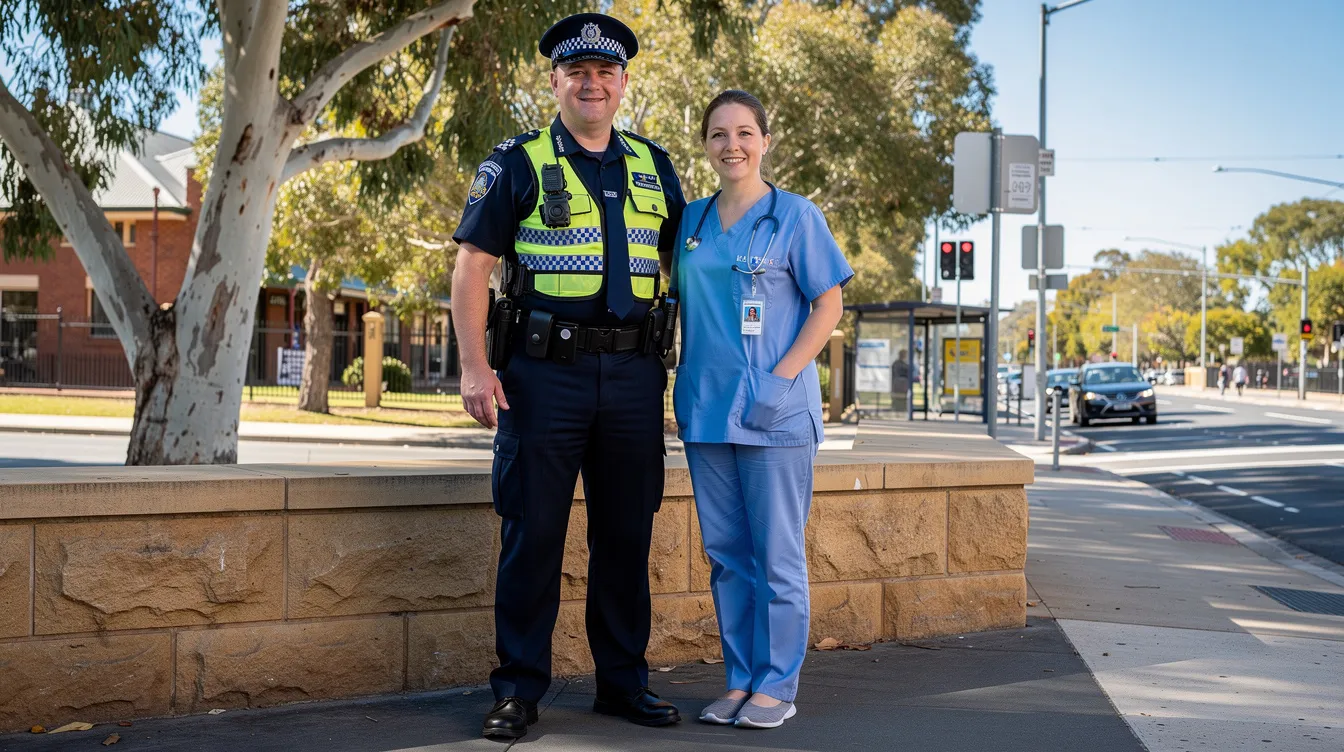
Car and Travel Expenses: When Police & Nurses Can Claim Car Expenses
Normal commuting expenses are generally not deductible unless you are transporting bulky essential equipment under strict conditions. Even if you work night shift, public holiday shifts or weekends, your drive between home and your usual workplace is private.
You can claim car expenses for:
Travel between workplaces on the same day (e.g. station to courthouse)
Trips to an alternate workplace such as a training college
Travel between separate jobs (e.g. hospital to aged-care shift)
Travel to offsite training courses or conferences
Police example: A constable based at Morley station drives to the Perth District Court for a hearing, then to a second station for overtime on the same day. The trips between workplaces may be claimable. Travel expenses between different police stations for shifts are deductible while normal commuting is not.
Nurse example: A registered nurse finishes a morning shift at Fiona Stanley Hospital and drives to an aged-care facility for a second job shift. Travel between jobs on the same day is deductible for nurses.
If you carry bulky tools or equipment (e.g. ballistic gear or forensic kits for police) and your employer provides no secure storage, you may be able to claim home-to-work travel in limited circumstances. This is rare and must be carefully assessed.
How to Claim Car Expenses: Logbook vs Cents-Per-Kilometre
The ATO provides two methods. Choose the one that matches your records and driving patterns.
Method | How It Works | Best For |
|---|---|---|
Cents-per-kilometre method | Claim a set rate per km, capped at 5,000 km per year. No receipts required, but you need documentation showing how you calculated your trips. | Officers or nurses with occasional work travel |
Logbook method | Keep a 12-week logbook showing business-use percentage. Track all car running costs (fuel, servicing, registration, insurance). | Nurses or police with frequent travel between multiple sites |
A nurse who regularly drives between two Perth hospitals may benefit from a logbook because her work kilometres are high and ongoing. A police officer who only occasionally travels to a training college or crime scene may find the kilometre method simpler.
Elite Tax and Wealth Advisory can help compare both methods using your real numbers to determine which produces the most accurate deduction.
Self Education Expenses: Courses, Conferences and CPD
Self education expenses must maintain or improve skills in your current job to be deductible. Study aimed at getting a new job or first qualification is generally not claimable.
For nurses: Nurses can claim self-education expenses for relevant courses. CPD activities required to maintain AHPRA registration, such as a wound management workshop, qualify. Education costs for short courses directly related to current employment duties can usually be claimed.
For police: Costs for courses and training directly related to a police officer’s role can be deducted. This includes defensive driving refreshers, leadership training courses when already in a supervisory role, and tactical updates that relate to your current job.
Claimable items typically include course fees, textbooks, professional publications, stationery, internet and printing for assignments, and travel to the course. Study to move into a completely different profession is not deductible, even if your employer tells you it would benefit your career in a general way.
Compulsory Uniforms, Protective Clothing and Laundry
To claim a tax deduction for uniforms, they must be compulsory uniforms that are distinctive to your role, such as bearing the employer’s logo or being occupation-specific.
Police officers can claim: official police force uniforms, bullet-resistant vests purchased personally, approved protective boots, duty belts, and safety gear not reimbursed by the employer. Police officers can claim uniform expenses as tax deductions, and expenses for protective equipment are deductible for police officers.
Nurses can claim: branded scrubs, compulsory hospital uniforms, occupation-specific non-slip shoes, aprons, goggles and gloves bought personally. Nurses can claim costs for compulsory uniforms and shoes.
Plain clothing such as black pants, generic business shirts or cardigans is generally not deductible. Cleaning plain clothing worn at work does not qualify, even if your employer requires a particular colour or style.
Laundry: Laundry costs for eligible work clothes are tax-deductible. The ATO allows approximately $1 per load for work-only washing and $0.50 for mixed loads. Police can claim laundry costs for their uniforms as deductions. Keep a simple diary of loads per week to support your claim.
Professional Associations, Registrations and Union Fees
Membership fees for unions or professional associations can be claimed as deductions. Union fees and professional development costs directly related to police duties are deductible.
Nurses: AHPRA registration fees, nursing union membership, midwives’ associations
Police: Police union fees, relevant professional body memberships
These fees are usually fully deductible in the year paid, provided the expense relates to your current employment. Fees paid to tax agents can generally be deductible in the income year the fees are incurred. Keep renewal notices in a dedicated tax folder.
Tools, Equipment and Technology Used for Work
Police: Torches, handcuffs, tactical bags, duty belts, personal body cameras if approved, and other tools you pay for and are not reimbursed
Nurses: Stethoscopes, blood pressure cuffs, fob watches, scissors, small medical kits
Low-cost items under the ATO’s instant asset threshold can be claimed immediately. More expensive equipment is depreciated over its effective life. For laptops, tablets or phones, claim the work related portion based on a reasonable percentage of work versus personal use.
Phone, Internet and Home Office Expenses
Nurses can claim mobile phone expenses for work-related calls. Police officers who use personal phones for rosters, call-outs and operational messaging can also claim.
Typical work use includes checking roster apps, contacting hospitals or stations, accessing online training, and reading clinical or operational updates. Deductions must reflect the work related part of your usage, ideally supported by a four-week representative diary.
Working from home deductions may apply under specific conditions, and expenses must be directly related to earning income. Nurses completing CPD at home or police officers writing reports from home may qualify. Simply reading emails occasionally will result in a small claim at best. Overclaiming phone and internet is a common ATO audit trigger.
Overtime Meals, Travel Allowances and Other Common Claims
Overtime meals: Expenses for meals consumed during overtime can be claimed if an overtime meal allowance was received under an industrial award and you actually purchased the meal. Keep receipts.
Travel allowances: Where you sleep away from home for regional secondments or rural nursing contracts, you may claim meals, accommodation and incidentals. A police officer on rural deployment or a nurse doing agency shifts in country WA can legitimately claim these travel expenses.
Shift loading and penalty rates: These are taxable income, not deductions, but related expenses such as travel between sites on a night shift may be deductible.
What Police & Nurses Cannot Claim as Tax Deductions
Understanding what you cannot claim is just as important as knowing what you can.
Travel between home and your regular station or hospital, even on call or carrying standard-issue gear
Plain clothing including black jeans, hoodies, or business suits
Personal grooming, cosmetics, haircuts or contact lenses
Fines and penalties such as parking tickets near the hospital
Study for a completely new occupation unrelated to your current job
Any expense already reimbursed by your employer – claiming these again is a mistake that can incur penalties
Allowances that have already been included in your income cannot be claimed as a separate deduction without corresponding expenditure
Record Keeping: What Records Police and Nurses Need
The ATO recommends keeping detailed records of all work-related expenses for claim substantiation. Police officers should keep receipts for all work-related expenses.
Keep receipts, invoices and bank statements for five years from lodgement
Digital formats are acceptable: phone photos, scanned PDFs, email confirmations
A valid 12-week car logbook is essential for the logbook method
Use a simple spreadsheet or app to track categories: uniforms, professional associations, car, self education and tools
Standard Deduction vs Itemising Work-Related Expenses
A standard work-related expense deduction has been announced to commence in 2027. Until then, and even after, police and nurses who keep good records can choose to claim actual expenses if they exceed the standard amount.
Some expenses like union fees and income protection insurance may sit outside the standard deduction. A nurse who itemises uniforms, car expenses, union fees and self education could claim significantly more than someone relying on a flat standard amount. Discuss with Elite Tax and Wealth Advisory which approach suits your situation each year.
Preparing for Your Tax Return: Pre-Lodgment Checklist
Use this as a practical checklist before your next tax return:
Income statement from employer (STP finalised in myGov)
Interest and dividend statements
Private health insurance statement
Uniform and laundry expense records
Car logbook and odometer readings
Self education expenses and course receipts
Professional association and union fee receipts
Tools and equipment purchase records
Phone and internet usage estimates
Overtime meal and travel records
Investment property, shares or managed fund details
Services Australia payment summaries if applicable
Create a digital “Tax Year 2025–26” folder on your phone now rather than scrambling at 30 June.
How Elite Tax and Wealth Advisory Helps Police & Nurses Maximise Legitimate Refunds
Elite Tax and Wealth Advisory is a Perth-based firm that regularly assists police officers, registered nurses and midwives with their tax returns and broader wealth planning.
We review your role, shift pattern and work locations to identify often-missed deductions like travel to an alternate workplace or under-claimed self education expenses
We use ATO prefill data plus targeted questions to uncover eligible claims while ensuring everything is properly substantiated
We look beyond the immediate refund to superannuation, salary packaging and medium-term wealth goals
Police and nurses across Morley and Perth can book a consultation in person or online
Common Mistakes Police & Nurses Make With Tax Returns
Claiming car expenses for normal home-to-work travel or logging every kilometre without separating private and deductible trips
Treating all clothing as deductible, including generic scrubs without employer branding or plain clothing
Claiming study for a new job as self education expenses linked to your current role
Using unrealistic phone and internet percentages (e.g. 90% work use) with no supporting log
Discarding receipts after reimbursement, then accidentally claiming the same cost again – a common mistake
Forgetting to include taxable allowances shown on your income statement
What Happens If You Make a Mistake on Your Tax Return?
A mistake on your return is not the end of the world. If you realise you have overclaimed or omitted income, you can request an amendment through your tax agent or myGov. The ATO prefers voluntary corrections.
Possible ATO actions include requests for information, data-matching reviews, and penalties for serious errors. Only claim deductions you can support with records and a clear link to your employment duties. Contact Elite Tax and Wealth Advisory to review a previous return if you are worried about an error.
Tax Planning Tips Before 30 June for Police and Nurses
Bring forward deductible expenses where cash flow allows: pay professional association fees or course fees before 30 June
Update your car logbook and complete a full representative 12-week period
Review uniform and equipment needs and time purchases strategically around the end of financial year
Consider additional concessional super contributions. Concessional contributions to superannuation are taxed at 15%, and the concessional contributions cap for the 2025–26 financial year is $30,000. The general concessional cap allows contributions up to $30,000 per financial year. Unused concessional contributions can be carried forward if your total super balance is under $500,000.
Have an early-year conversation with Elite Tax and Wealth Advisory in April or May to plan ahead rather than reacting after the year has finished
Case Study 1: Metropolitan Police Officer’s Tax Return
Profile: Constable based at a metropolitan Perth station, working rotating shifts with occasional court appearances and training days.
Deductions claimed: Travel between station and court ($480 using cents-per-kilometre), compulsory uniforms and protective gear ($650), laundry ($260), union fees ($520), overtime meals ($340), work related phone use ($180), defensive driving refresher course ($350)
Approximate total deductions: $2,780 – reducing taxable income and producing a noticeably better refund than someone who claims nothing or guesses amounts
Accurate logs and receipts made the process straightforward. Working with Elite helped the officer avoid common overclaim pitfalls and identify the maximum refund available within ATO guidelines.
Case Study 2: Hospital Nurse Working Across Multiple Sites
Profile: RN at a Perth public hospital, also picking up agency shifts at a private hospital and aged-care facility.
Deductions claimed: Car expenses between hospitals using logbook method ($1,200), branded scrubs and shoes ($420), laundry ($210), AHPRA registration ($210), nursing union fees ($480), CPD conference and wound care course ($680), work related phone use ($160)
Approximate total deductions: $3,360 – a significant benefit compared with making minimal claims
A structured record-keeping system using a digital folder, logbook and simple diary made lodging her return faster and less stressful despite shift work at her second job and primary hospital.
Beyond This Year’s Tax Refund: Building Wealth for Police & Nurses
Your tax return is one part of a longer-term wealth strategy. Police officers and nurses often have stable income but demanding schedules that leave little time for financial planning.
Use tax time to review superannuation contributions, insurance cover and savings plans
Explore salary packaging options where available in hospital or government employment
Elite Tax and Wealth Advisory integrates tax planning with financial planning, lending advice and services like preparing for a home loan or investment property
View your return as a regular checkpoint toward broader financial goals, not just an annual chore about money back in your pocket
How to Work With Elite Tax and Wealth Advisory
In-person appointments at our Morley office, video calls for shift workers who cannot attend during normal business hours, and secure online document sharing
Bring your last year’s tax return, year-to-date payslips, prefilled myGov details, and the receipts listed in the checklist above
Our team tailors questions specifically for police officers and nurses to ensure all role-specific deductions are considered
Book a consultation to simplify your next tax return and discuss broader financial goals in the same conversation
Summary: Key Takeaways for Police and Nurses at Tax Time
Good records, understanding what you can and cannot claim, and starting early in the tax season are the foundations of a maximum refund that is fully legitimate
The most common deduction categories: car expenses for work-related travel, compulsory uniforms and protective gear, self education, professional associations and union fees, tools and equipment, and reasonable phone and internet use
Avoid common mistakes: do not claim private clothing, home-to-work travel, or guess amounts without documentation
The ATO recommends keeping detailed records for five years – digital copies on your phone work fine
If you want peace of mind that your return is correct and aligned with your long-term financial plans, speak with Elite Tax and Wealth Advisory. We are here to help simplify the process and ensure you are claiming everything you are entitled to, without the risk of overclaiming.


