


What Can Nurses Claim on Tax? A Complete Guide
If you work as a registered nurse, enrolled nurse, or midwife in Australia, understanding effective tax strategies for nurses can put real money back in your pocket each year. Tax deductions reduce taxable income, which means a lower tax bill or a bigger refund. This guide covers what nurses and midwives can claim on their tax return, with practical examples, record-keeping tips, and common pitfalls to avoid.
Quick answers: the main tax deductions nurses can claim
Australian nurses and midwives can claim a deduction for a wide range of work related expenses, provided those expenses meet ATO requirements. Common deductions include car expenses for work-related travel (not your daily commute), occupation specific clothing and laundry, overtime meal expenses, self education linked to your current job, professional association fees, and work tools like stethoscopes and other medical equipment.
Nurses in Perth can claim deductions for work-related expenses just like nurses anywhere in Australia, as long as the ATO’s rules are satisfied. Here are the top 10 claim areas for nurses and midwives:
Car expenses for travel between workplaces, patient visits, or off-site clinics
Scrubs, protective clothing, and compulsory uniforms
Laundry expenses for eligible work clothes
Overtime meals when you receive an overtime meal allowance
Annual practising certificate renewal with AHPRA
Union fees and professional association fees
Professional publications and journal subscriptions
Self education and CPD courses linked to your current role
Phone and internet costs for work related phone calls and tasks
Home office expenses for admin and CPD completed at home
All examples in this guide are based on ATO rules for Australian residents. Elite Tax and Wealth Advisory is a Perth-based firm that helps nurses optimise both their tax position and their long-term wealth strategy. The sections below walk through each category in detail, with practical examples and record-keeping tips.

Golden rules: when can nurses claim a tax deduction?
Before diving into specific categories, every tax deduction must pass three core ATO tests. You must have spent the money yourself and not been reimbursed, the expense must relate directly to earning your nursing income in your current job, and you must keep records to support all claimed deductions.
You cannot claim a deduction for:
Costs your employer reimburses or employer pays on your behalf
Purely private expenses such as everyday clothes, normal lunches, childcare, or commuting fuel
Expenses that have no direct connection to your current employment duties
For a registered nurse, enrolled nurse, or midwife, the test is always “does this help me do my current role?” rather than “does this help my career in general?” Deductions must directly relate to earning income in the position you hold right now.
You are personally responsible for all claims in your return, even if a registered tax agent lodges it for you. Over-claiming car expenses or laundry is a common audit trigger for nurses. Nurses should avoid claiming expenses already reimbursed by their employer. Receipts are required for substantiating claims for deductions, so use the ATO myDeductions tool or a simple spreadsheet to track expenses during the year rather than trying to reconstruct them in June.
Car expenses: what nurses can and can’t claim
Car expenses are one of the biggest areas of confusion for nurses and midwives, especially those working across hospitals, aged care facilities, and agencies in various healthcare settings.
You can claim car expenses for work-related travel. This includes driving between two hospitals on the same day, travelling from your usual ward to an off-site clinic, visiting patients in the community, or travelling to training courses that directly relate to your current job when you are not reimbursed. Travel expenses between different work sites can be claimed.
Travel between home and work is generally not deductible. You generally cannot claim car expenses for trips between home and your usual workplace, even if you work night shift, weekends, carry small equipment, or have a long commute. This is treated as a private expense.
You may be able to claim if you carry bulky tools or carry bulky equipment, but only under narrow conditions: the employer requires you to transport genuinely bulky or awkward items, there is no secure storage at work, the equipment is an essential part of your duties, and it is bulky (for example, over 20 kg or awkward in size).
Specific examples where nurses can claim:
An agency nurse driving between separate jobs at different client facilities in one day
A community midwife visiting multiple patients at home using her own car
A practice nurse attending a vaccination clinic at an alternative workplace or alternate workplace in a different suburb
Travelling to an off-site aid courses or training courses venue that is not your usual clinic
Records must distinguish private versus work-related use. Logbooks and odometer readings are key evidence.
How to claim car expenses
Australia has two main ATO methods to claim car expenses, and nurses should choose the one that best fits their pattern of use.
Cents-per-kilometre method: You can claim up to 5,000 kilometres using the cents per kilometre method per car per year. For FY 2025–26, the rate is 88 cents per eligible kilometre. You do not need fuel or service receipts, but you must be able to show how you calculated the distance using a diary, calendar, or app.
Logbook method: Keep a logbook for at least 12 consecutive weeks that represents your typical travel patterns. Record all trips with dates, destinations, and purpose. Calculate the business-use percentage, then apply that to your total car running costs such as fuel, registration, insurance, servicing, and decline in value.
Nurses who regularly drive between workplaces in Perth or across regional WA often get a better result using the logbook method, but it requires more disciplined record keeping. If you drive your own car between separate jobs or to a second job at different sites, it is worth modelling both methods. Elite Tax and Wealth Advisory can help compare both methods using real figures from your situation before lodging your return.
Car expenses nurses and midwives can’t claim
Incorrect car claims are a major ATO focus area for health professionals. Key non-deductible trips include:
Home to your regular hospital or aged-care facility and back, even for double shifts, on-call, or the same employer across multiple rosters
Detours to pick up coffee or groceries
Purely private detours when driving between workplaces
Trips where your employer reimburses you per kilometre
You cannot claim fines, parking fees at your usual workplace, or costs of getting or renewing a normal driver’s licence as car deductions. You cannot claim costs for renewing your driver’s license.
Before estimating kilometres, check your rosters and diary to confirm which trips are genuinely work-related.
Travel and accommodation for nurses
Some nurses and midwives travel overnight for conferences, training, or temporary placements and may be able to claim travel expenses. Claimable costs can include:
Airfares or transport to the event
Taxis or rideshare between the airport and accommodation
Accommodation costs for nights away from home
Reasonable meals when travelling overnight for work and not reimbursed
The primary purpose of the trip must relate to your current employment. For example, attending seminars at a midwifery conference that is directly tied to your position as a registered midwife.
Where a trip is partly private (say, you add a personal weekend after a two-day conference), expenses must be apportioned. Only work-related days can be claimed. You cannot claim local day-to-day transport between home and your regular workplace, or family holiday costs, even if you check work emails while away.
A travel diary is essential for work-related travel claims, particularly for trips of six or more consecutive nights. Keep invoices for flights, accommodation, and meals.
Clothing, uniforms and protective gear
There is a clear distinction between occupation specific clothing, protective clothing, and everyday wear. Only specific categories are deductible.
Nurses can claim costs for compulsory uniforms and shoes, including:
Compulsory uniforms with employer logos or a distinctive uniform
Specific branded scrubs required by your hospital or agency
Occupation specific clothing that clearly identifies you as a nurse
Protective clothing like non slip nursing shoes, safety goggles, aprons, and gloves if you pay for them yourself
Protective clothing like scrubs is tax-deductible for nurses. Nurses cannot claim deductions for plain clothing worn at work, even if the employer requires a certain colour or dress standard, and even if you only wear them at work. Cleaning plain clothing worn for work is not deductible. You cannot claim for ordinary clothes.
If your employer reports a clothing or laundry allowance on your income statement or payment summary, you must declare it as income. Receiving an allowance does not automatically entitle you to claim a matching deduction. Accurate descriptions on receipts (for example, “branded scrub top – XYZ Hospital”) help justify claims for eligible work clothes if the ATO asks questions.
Laundry and dry-cleaning for nurses
Nurses and midwives can claim laundry and dry-cleaning costs for eligible work clothes only. Laundry costs for work uniforms can be claimed as deductions. This includes compulsory, protective, or occupation specific garments such as scrubs with hospital logos or specific theatre uniforms.
For laundry claims under $150, no receipts are needed. Claims for laundry expenses under $150 do not require receipts, but you still need a reasonable basis for the laundry claim, such as number of washes per week and cost per load.
If your total work related expenses exceed $300, you must provide written evidence for the entire amount, not just the portion above $300.
Dry-cleaning costs for eligible items are deductible. Laundry for non-eligible everyday clothing is not claimable and cannot be estimated casually.
Worked example: A Perth ICU nurse washes 3 sets of scrubs 3 times per week for 50 weeks. If each load costs around $5, the annual laundry expenses come to approximately $750. That is a legitimate claim, provided the nurse can show the calculation and keeps receipts if total work-related expenses exceed $300.
Meal expenses and overtime meals
Meal expenses during regular shifts are not deductible. Normal meals during your usual shift, including breakfast, lunch, dinner, snacks, and coffee, are a private expense, even if you work long hours or night duty.
Travel-related meals may be deductible when you are required to stay away from home overnight on work business, as covered above.
Nurses can claim overtime meal expenses if allowed, but only when strict conditions are met:
You must receive a genuine overtime meal allowance under an industrial award, enterprise agreement, or industrial law provision
The overtime meal allowance must be included in your assessable income and shown on your income statement
Your claim can only relate to occasions when overtime was actually worked
You can claim a reasonable amount for overtime meals without receipts. For FY 2025–26, the ATO’s reasonable amount is $38.65 per overtime meal. If you claim more than that amount, keep receipts for overtime meal claims to substantiate deductions. If you claim at or below the reasonable rate, you still need to show how many overtime shifts you worked.
Self-education and CPD for your current job
Nurses and midwives must maintain skills and complete continuing professional development (CPD), and many self education expenses are deductible if they have a direct connection to your current nursing role and nursing practice.
Nurses can claim self-education expenses directly related to their job. Examples of deductible self education include:
Postgraduate subjects in intensive care for an ICU nurse
Diabetes education or wound care courses for a community nurse (courses like wound care are claimable if job-related)
Neonatal workshops for a midwife
Conferences where topics match your current ward or speciality
Expenses for self-education directly related to nursing are claimable. However, self-education costs for new job training are not claimable. A course aimed at getting a new job or a first nursing role (for example, moving from personal care assistant to registered nurse, or from nursing to a completely different field) is generally not deductible. Nurses cannot claim study costs for unrelated job roles.
Claimable self education expenses include course fees and textbooks not reimbursed by your employer, study expenses for reference materials, stationery, professional publications, and travel to the course venue when it is not your normal workplace. Since 1 July 2022, the old $250 reduction for certain self education expenses no longer applies, but it is always best to check with an accountant for the relevant income year.
Keep course outlines, invoices, and attendance certificates. The ATO offers a self-education expenses calculator that can help you work out your claim.
Professional fees, registrations and publications
Staying registered and informed is an essential part of working as a nurse or midwife, and many of these costs are deductible.
Nurses can claim annual AHPRA registration fees as deductions, as well as nurses can claim the cost of renewing their annual registration fees for the annual practising certificate with the Nursing and Midwifery Board of Australia
Initial AHPRA registration fees are not deductible for new nurses
Union fees (such as ANMF) and professional association fees where membership relates to your nursing role
Agency fees you pay personally for placement services
You can claim the cost of professional journals related to nursing, including subscriptions to the Australian Nursing & Midwifery Journal, online databases, or educational platforms paid for personally and used for your current job
Check your income statement or payslips to see whether your employer reimburses or pays any of these fees, because you can only claim a deduction for the portions you actually paid. Keep email receipts for AHPRA registration fee claims. Store annual invoices and bank statements or credit card statements for at least five years after lodging the relevant tax return.
Tools, equipment, home office and phone use
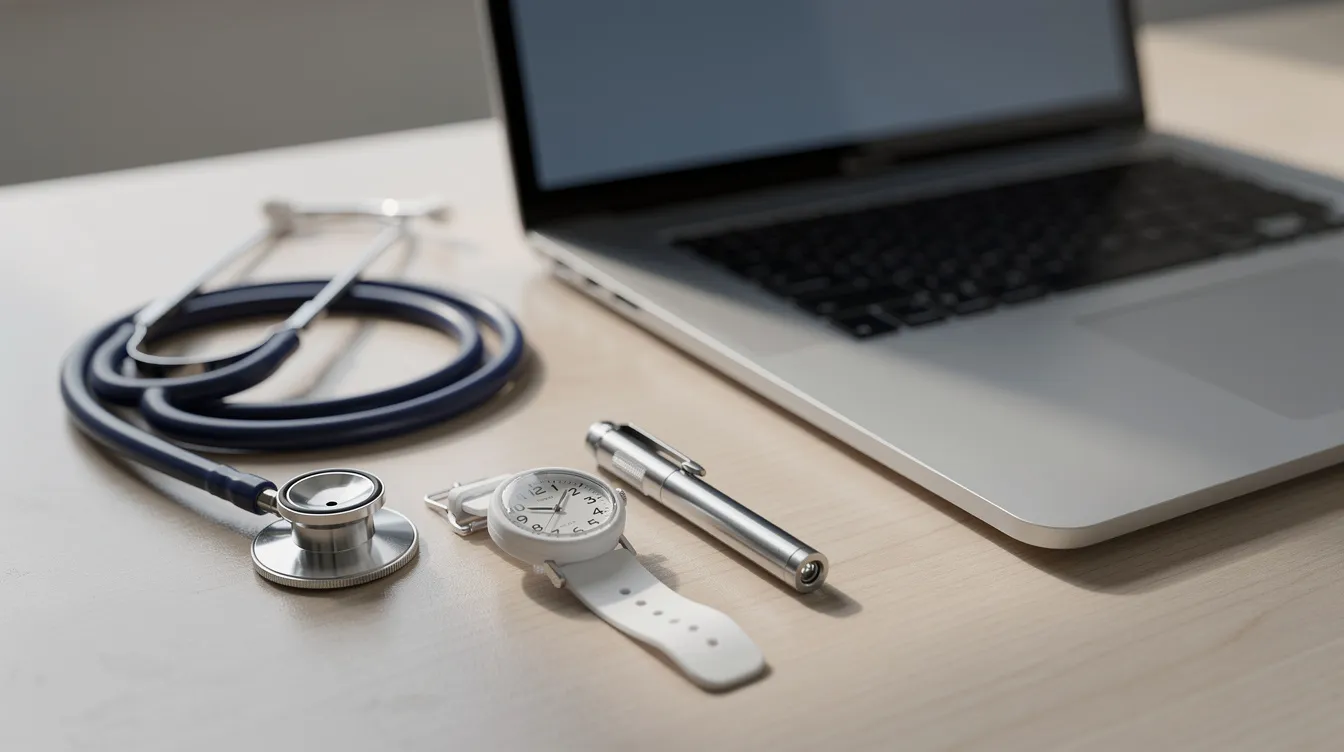
Many nurses buy their own small tools and technology. Nurses can claim tools like stethoscopes and medical equipment, along with other medical equipment not supplied by their employer. Common items include:
Stethoscopes, blood pressure cuffs, pen lights, nursing fob watches
Reference books and organiser apps
Specialised medical equipment or other medical equipment your employer does not provide
Equipment costing $300 or less and used mainly for work qualifies for an immediate deduction in the year of purchase. More expensive items (such as laptops or high-end tablets) must be depreciated over their effective life, with only the work related portion claimable. You can claim the cost of repairing work-related tools and equipment as well.
For phone and internet use, you can claim the work related portion of your mobile phone and home internet costs if you regularly use them to check rosters, contact your ward or agency, complete online CPD, make work related phone calls, or update clinical records from home. Keep a one-month usage diary or itemised bill showing work versus private calls and data, then apply that percentage to your annual internet costs and phone expenses.
For home office expenses, nurses who complete admin or study at home for their current job can claim running costs. The ATO offers a fixed-rate method and an actual-cost method. Phone use may already be covered under the fixed-rate approach, so check before doubling up.
Common mistakes nurses and midwives make at tax time
The ATO publishes occupation-specific guidance for nurses, midwives, and direct carers and closely monitors certain deduction patterns. Typical errors include:
Claiming car expenses for home-to-hospital travel (even for night shifts or when you work for the same employer)
Overstating a laundry claim without a reasonable basis
Claiming everyday clothing as occupation specific when it is not a distinctive uniform
Treating career-change study as deductible self education when it leads to a new job rather than supporting your current job
Not declaring allowances (overtime meal allowances, uniform allowances) as increased income on your tax return while still claiming deductions against them
Under-claiming is also a problem. Nurses often forget items like union fees, annual practising certificate renewals, small tools, professional publications, agency fees, and interest on money borrowed to buy work-related equipment.
Review the ATO “Nurses, midwives and direct carers” guide each year. If your circumstances are complex, for example if you work for multiple agencies, do FIFO nursing, or own an investment property, seek tailored advice from a tax agent before lodging.
Record keeping and preparing for 30 June
Good records are the easiest way to maximise legitimate deductions and avoid ATO issues. Detailed records can lead to higher legitimate deductions according to the ATO.
Checklist of records nurses should keep:
Record type | Examples |
|---|---|
Income | Payslips, income statements, payment summary details, overtime and allowance breakdowns |
Car expenses | Logbook, odometer readings, diary of work trips |
Clothing | Receipts or invoices for uniforms, protective clothing, non slip nursing shoes |
Professional fees | Statements for union fees, AHPRA registration, professional association fees |
Self education | Course invoices, CPD certificates, textbook receipts |
Tools and equipment | Purchase receipts, repair invoices for stethoscopes and other medical equipment |
Phone and internet | Itemised bills, one-month usage diary showing work related portion |
Bank records | Bank statements and credit card statements showing payments |
Keep receipts for all work-related expenses over $10. You can keep digital copies of receipts for tax purposes, provided they are legible. Maintain records for at least five years after lodging your tax return.
Set aside a small amount of time each month to upload receipts to a cloud folder or accounting app, rather than scrambling at the end of the financial year. Nurses in Perth and across Western Australia should treat tax time as a chance to review their broader financial position, including super contributions, savings goals, and debt levels, not just their deductions.
When to get personalised advice from Elite Tax and Wealth Advisory
While many nurses can handle straightforward claims themselves, professional advice adds real value when income sources, investments, or work patterns become more complex.
Speaking with Elite Tax and Wealth Advisory is especially helpful if you are:
Working for multiple hospitals or agencies, potentially in separate jobs
Carrying significant car expenses and needing help choosing between cents-per-kilometre and logbook methods
Completing postgraduate study while working and unsure which study expenses qualify
Owning or planning to buy an investment property in Perth
Starting a side business alongside your nursing practice
Looking at salary sacrificing, super contributions, or debt-reduction strategies
Elite works as a long-term financial partner, not just a once-a-year tax return service. We help nurses align their tax position with broader wealth goals such as building superannuation, paying down debt, and planning for family needs.
If you are a nurse or midwife preparing your 2025–26 tax return, book a consultation with our Perth team. Let us help you claim deductions you are entitled to and build a financial plan that works beyond tax time.


